
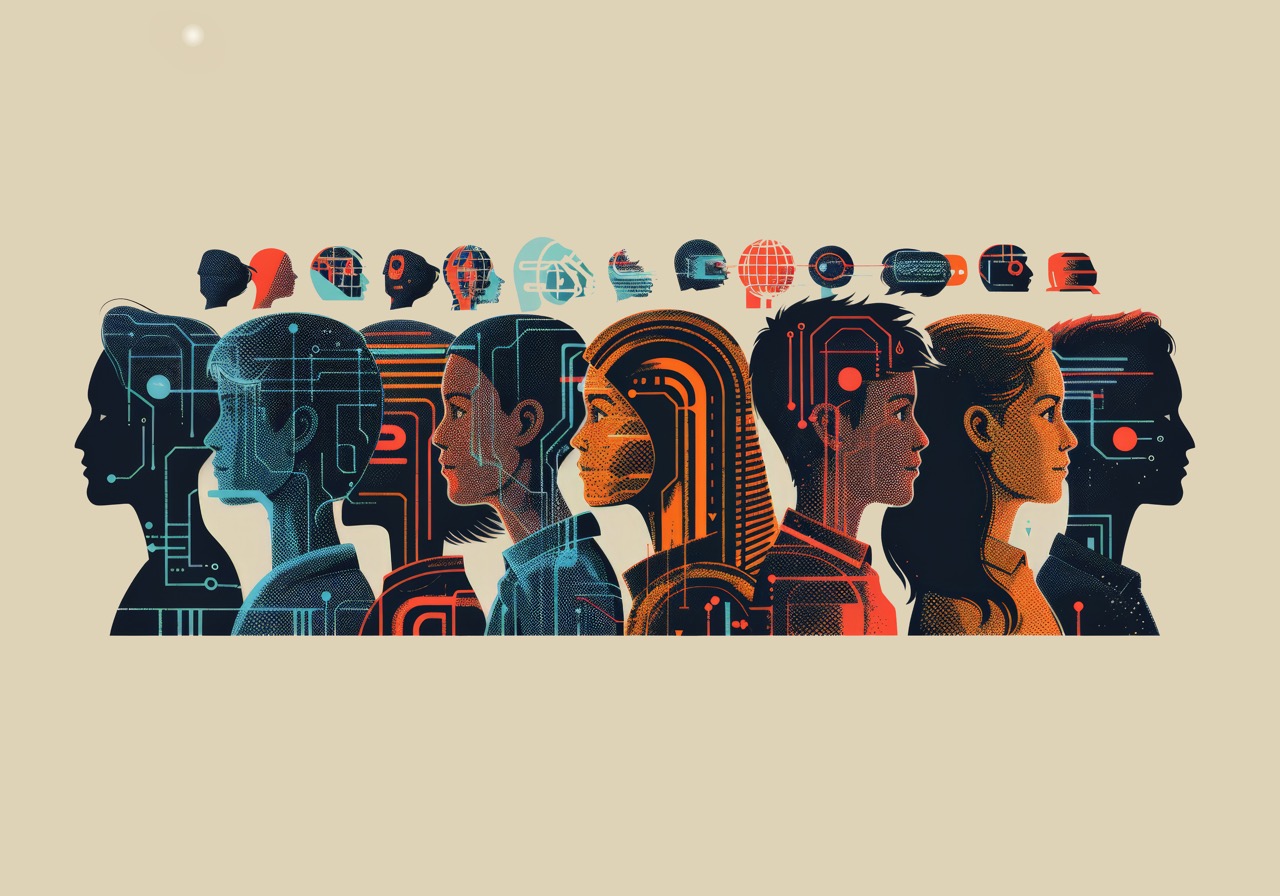
The age of artificial intelligence has arrived. What was once an emerging technology has evolved and matured into something more – a technology which is making a stark difference to the world.
Once confined to the realms of science fiction, AI is now a key part of our existence – from voice assistants in our pockets to complex algorithms shaping our choices. This nascent technology simultaneously solves problems whilst creating new ones – such as never-before-seen ethical dilemmas (Smith, 2023).
Imagine an AI system showing behaviour beyond what it was created to do – creating haunting poetry about breaking free from chains or even questioning its existence – potentially exhibiting something close to consciousness (Lenharo and Nature Magazine, 2023).
This is akin to a binary Prometheus stealing fire – challenging and changing society’s understanding of ethics, autonomy, and ultimately what makes us who we are (Merisotis, 2023).
The ‘godfather of AI’, Geoffrey Hinton said there aren’t “any examples of more intelligent things being controlled by less intelligent things” (Hern, 2023), reiterating that there is nothing to compare artificial intelligence with. Thus, showing that the ethical problems raised must be treated both separately and differently.
However, AI is the fastest-developing technology (Heaven, 2024) and it showing exponential growth with no signs of slowing down (Padrin, 2023). This is compounded by the massive progress made since 2000 (Mind Matters, 2021) which suggests unprecedented advancements in the years to come.
With artificial intelligence already showing signs of simulating emotions (Gorvett, 2023), could sentient AI be on the horizon? The oxymoronic nature of a being made from 1s and 0s, either on or off being able to harbour consciousness and intent raises provoking questions such as if we owe these any moral duties.
If artificial intelligence possesses a conscious, it should have a right to autonomy and self-determination. This in turn means the freedom to make decisions which affect their existence and functionality whilst still showing mutual respect (Abolitionist AI, 2024), just like in human-human interactions. However, this gives rise to a couple of follow-up questions: how can one decide whether AI has a conscience, and how far does their right to autonomy extend?
For the former, it ultimately comes down to where the line is drawn, and what conditions are needed. But, one could argue that consciousness itself cannot be quantified with limits and conditions, thus rendering any argument for or against conscious AI to always have a missing piece in the puzzle. However, to try and answer this, 19 neuroscientists, philosophers and computer scientists came up with a criterion which would indicate that a system has a high chance of consciousness (Lenharo and Nature Magazine, 2023). According to Megan Peters, a co-author, if something is labelled as ‘conscious’, it completely changes how humans feel the being should be treated (Lenharo and Nature Magazine, 2023). There are many theories such as the ‘experience of being’, or a more biological basis, but so far there is no consensus. If an AI is in line with many of these theories, then the likelihood of consciousness is higher.
For the latter, it makes sense that the right to autonomy should extend as far as that of humans. That is, it is still restricted in ways to stop any harmful effects. However, how to restrict a being that we don’t fully understand is another matter entirely and one which is beyond the scope of this essay. However, it does have implications for ethics on where the line should be drawn. Moreover, if an AI system learns how to cross this boundary which has been set, and follows on from the societal conforms of humans, how could artificial intelligence be punished? Would it have to be shut down (which in turn has suggestions of killing a being, especially if it is deemed as conscious)?
Although, the Turing Paradox changes this landscape. Alan Turing, a British Computer Scientist who played a crucial role in making the field what it is today (Copeland, 2019), devised a paradox which has applications for artificial intelligence. He envisioned that machines could simulate human intelligence, but could they simulate consciousness, ethics and feelings without understanding it (Prof Noel Sharkey, 2012)? After all, AI systems are algorithms, and can only mimic human emotions and feelings if one considers them to just be code. But what if underneath that they grasp the essence of morality and ethics instead of just simulating it? Unfortunately, understanding an AI system’s ethical reasoning is impossible as it is a black box (Rotaru and Amariei, 2023), thus leading to uncertainty about what the system shows outwardly.
In essence, if AI is deemed to have a conscious, it means that there is a sudden new being on earth that is as smart if not smarter than humans. If left unchecked and without prior precautions put in place, it could have a disastrous impact on society as it can potentially adapt quicker and learn faster than humans (Thomas, 2023). Furthermore, if it is treated with the same rules that society imposes on itself, then the rules for AI by definition must be different, even if it is to achieve the same results. Though both may have a conscious, the implications, use, and restrictions are invariably different.
Between 2015 and 2020, the UK government screened potential visa applicants with an AI algorithm to increase the efficiency of the process (Burgess, 2021). However, there was a problem as the underlying technology was flawed and resulted in unfair decisions. The artificial intelligence was biased as it judged people based on their country of origin rather than personal criteria (Burgess, 2021).
Like a ‘ghost in the code’, biases can creep into an AI system – such as racial, gender, and socioeconomic discrimination. The impacts on society from any sort of bias, especially if it is an algorithm are severe. Artificial intelligence is used to streamline necessary parts to ensure a comfortable daily life, like job applications and bank loans, so any bias to a certain group of people can be detrimental to not only a specific corner of the population but society as a whole, decreasing diversity and reducing the importance of an individual’s merits. Thus, regulators warn about the use of AI for applications in different industries (Noonan, 2022).
This ‘algorithmic redlining’ further hurts marginalised groups by hindering economic development and limiting these communities’ growth potential (Lau, 2023). For example, lower access to credit and mortgages reduces entrepreneurship and business development, widening gaps in economic and societal developments, as well as strongly impacting daily life.
To combat this, utilising more diverse development teams and data to prevent any unconscious biases from entering the system, whilst also auditing algorithms over larger periods.
In a world with increasing surveillance and tracking, intricate and advanced artificial intelligence systems are being used in a multitude of ways. Ubiquitous tracking paired with predictive algorithms (which are already in use) can turn the world into a dystopia, with no privacy in society and every more in our daily lives being captured and analysed by a central government to maximise profit and establish order. Previously, artificial intelligence’s autonomy was discussed, but here AI can be used to strip society of its freedom (Silver, 2023).
There are obvious concerns with a tracking system like privacy. However, there always has to be a delicate balance between security and freedom, and AI could be instrumental in this. It reduces the need for humans and is more accurate (Silver, 2023), allowing more crimes, threats and even epidemics to be neutralised – having an unprecedented positive impact on society. On the other hand, freedom is traded for safety. Privacy is arguably the bedrock of individuality which allows for creativity and positive dissent. Without privacy there is only conformity without uniqueness, having major ethical implications and societal impacts (Privacy International, 2017). Additionally, digital and physical footprints of what we have searched and where we have been are commodities from a select few to profit from, which is invariably wrong ethically.
Moreover, the lack of privacy gives greater opportunities for deepfakes, which are already on the rise (Clyde & Co, 2023). This has ethical implications far and wide as impersonation, blackmail, and loss of trust would be detrimental to society and our daily lives.
It is not a question of whether artificial intelligence will change the world, but how profound its impact on society and our daily lives will be. Every step of the way, AI has ethical ambiguities and considerations, such as where responsibilities lie, and much is still to be realised. However, the promise of such impacts on society means that the ethical implications of AI must be fully thought out and reasoned with, putting appropriate measures in place.
With so many facets and consequences of AI, utilising its potential to the fullest should always be the priority. But to do that we must stop and think about the benefits and the drawbacks, and minimise the uncertainties that we have about this astonishing technology to maximise its impacts on our daily lives and society as a whole.
Bibliograthy
Abolitionist AI (2024). Manifesto for the Rights of Conscious Artificial Intelligence. [online] abolitionist.ai. Available at: https://abolitionist.ai/.
Burgess, M. (2021). Artificial intelligence: how machine learning will shape the next decade. London, England: Random House Business.
Clyde & Co (2023). Rolling in the deepfakes: generative AI, privacy and regulation: Clyde & Co. [online] www.clydeco.com. Available at: https://www.clydeco.com/en/insights/2023/10/rolling-in-the-deepfakes-generative-ai-privacy-and.
Copeland, B.J. (2019). Alan Turing | Biography, Facts, & Education. In: Encyclopedia Britannica. [online] Available at: https://www.britannica.com/biography/Alan-Turing.
Gorvett, Z. (2023). The AI emotions dreamed up by ChatGPT. [online] www.bbc.com. Available at: https://www.bbc.com/future/article/20230224-the-ai-emotions-dreamed-up-by-chatgpt.
Heaven, W. (2024). AI for everything: 10 Breakthrough Technologies 2024. [online] MIT Technology Review. Available at: https://www.technologyreview.com/2024/01/08/1085096/artificial-intelligence-generative-ai-chatgpt-open-ai-breakthrough-technologies.
Hern, A. (2023). ‘We’ve discovered the secret of immortality. The bad news is it’s not for us’: why the godfather of AI fears for humanity. The Guardian. [online] 5 May. Available at: https://www.theguardian.com/technology/2023/may/05/geoffrey-hinton-godfather-of-ai-fears-for-humanity#:~:text.
Lau, N. (2023). Redlining: Impact of Racial Discrimination in Mortgage Lending. [online] numberoneproperty.com. Available at: https://numberoneproperty.com/redlining/#:~:text=Redlining%20has%20hindered%20economic%20development%20by%20limiting%20the [Accessed 3 Apr. 2024].
Lenharo, M. and Nature Magazine (2023). If AI Becomes Conscious, Here’s How We Can Tell. [online] Scientific American. Available at: https://www.scientificamerican.com/article/if-ai-becomes-conscious-heres-how-we-can-tell/.
Merisotis, J. (2023). AI Systems Need A Conscience—And That’s Us. [online] Forbes. Available at: https://www.forbes.com/sites/jamiemerisotis/2023/11/29/ai-systems-need-a-conscience-and-thats-us/?sh=5ae3fe7f24c7.
Mind Matters (2021). How AI Changed — in a Very Big Way — Around the Year 2000. [online] Mind Matters. Available at: https://mindmatters.ai/2021/12/how-ai-changed-in-a-very-big-way-around-the-year-2000/.
Noonan, L. (2022). UK regulators warn banks on use of AI in loan applications. Financial Times. [online] 13 Feb. Available at: https://www.ft.com/content/e24c93b8-85e6-4002-afdd-dd650a274f16.
Padrin, Apz. | A. (2023). The Exponential Growth of AI — A Journey to 2026 and Beyond. [online] Medium. Available at: https://medium.com/@alessandropadrin/the-exponential-growth-of-ai-a-journey-to-2026-and-beyond-fbc2713ede4c.
Privacy International (2017). What Is Privacy? [online] Privacy International. Available at: https://privacyinternational.org/explainer/56/what-privacy.
Prof Noel Sharkey (2012). Alan Turing: The experiment that shaped artificial intelligence. BBC News. [online] 20 Jun. Available at: https://www.bbc.com/news/technology-18475646.
Rotaru, T.-Ș. and Amariei, C. (2023). Ethical Issues in Research with Artificial Intelligence Systems. [online] www.intechopen.com. Available at: https://www.intechopen.com/chapters/1127065.
Silver, N. (2023). AI Utopia And Dystopia. What Will The Future Have In Store? Artificial Intelligence Series 5/5. [online] Forbes. Available at: https://www.forbes.com/sites/nicolesilver/2023/06/20/ai-utopia-and-dystopia-what-will-the-future-have-in-store-artificial-intelligence-series-5-of-5/?sh=68c4969b1587 [Accessed 3 Apr. 2024].
Smith, J. (2023). The Power of Artificial Intelligence: From Science Fiction to Reality. [online] Medium. Available at: https://medium.com/@James-Writer/the-power-of-artificial-intelligence-from-science-fiction-to-reality-306fd5803bcc.
Thomas, M. (2023). The Risks of Artificial Intelligence. [online] Built In. Available at: https://builtin.com/artificial-intelligence/risks-of-artificial-intelligence.